
The Necropastoral
Fixed air: occult systems, leaky borders, containers
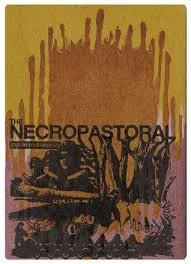
Joyelle McSweeney’s The Necropastoral interrogates the cultural history of the deadly landscape, from the annihilating plagues of Lucretius’ De Rerum Natura to the aftermath of 9/11.
Explicitly modelled on a classical poetics, this volume bears both physical and intangible traces of violent crime ranging from blood and bodily fluids to the “spectral quality of capitalism, the way money and debt accrues and erodes in damaging patterns, the way damage to bodies is sometimes the first materialisation of corporate malfeasance.”
The necropastoral offers a key to looking at obscured but visible worlds that exist in the interstices of the media, the spectacle, the haunting. By reversing the sense of order that the pastoral has traditionally sought and been concerned with “bodies, living, dead, ghostly, inhuman, artificial” the necropastoral is:
The lethal double of the pastoral and its fantasy of permanent, separated, rural peace. In emphasising the counterfeit nature of pastoral, the necropastoral makes visible the fact that nothing is pure or natural, that mutation and evolution are inhuman technologies, that all political assertions of the natural and the pure are themselves moribund and counterfeit, infected and rabid.
In this description the classical pastoral is invoked not as a perfect inversion of the necropastoral, but rather the necropastoral uncovers the “morbid, counterfeit nature” of the classical pastoral. By describing symbols that originally occur within the paradigm of the pastoral such as “milk” and “a permanent, separated rural peace” the necropastoral shows the fantastic nature of these symbols, and reveals that “nothing is pure and natural, that mutation and evolution are inhuman technologies.”
By revealing the necropastoral and revealing the long history of plague, death and infection which has haunted the classical vision of the pastoral, McSweeney brings the two states, that of the pastoral and the necropastoral, into combination and reveals the leaky borders which comprise our perception of “ecology, globalization” and “the occult way capitalism’s distribution systems amplify economic, political, biological damage as it spreads across the globe.”
Just as Lucretius’ De Rerum Natura offered a poetics of annihilation, plague and death in an inversion of the classical pastoral, so McSweeney updates Lucretius for the “eviscerating, flammable contemporary world” and tells us that the necropastoral has destroyed “the idea of the bordered or bounded body and marked the porousness of the human body as its most characteristic quality.” Described as a “supersaturated, leaking membrane” the necropastoral is concerned with hauntings, leakages, and biological traces.
McSweeney’s own words on the necropastoral can help us to understand her interest in the fraudulent and artificial forms of nature: “The Pastoral, like the occult, has always been a fraud, a counterfeit, an invention, an anachronism. However, as with the occult, and as with Art itself, the fraudulence of the pastoral is in direct proportion to its uncanny powers” she also says that “The Pastoral, after all, is the space into which the courtiers must flee in the time of plague, carrying the plague of narrative with them.”
This interest in both the counterfeit and the contaminant is clearly recognisable in McSweeney’s poetry. The abject is evident both in the disgust and disease that McSweeney evokes and also in her interest in abjected or excluded peoples. An example of these two modes in combination can be seen in the following lines that have a symbolic resonance with Nazism and its victims:
(I live in a starhouse built for denial
Hygienists in Scarsdale.
A case of adolescent sarc-
Oma.
It has six dental points despite the five on my papers. Despite
the Nazi hinges.
Structurally this stanza is abject; it opens but does not close the parentheses perhaps signifying an inability to incorporate such horror neatly into art. The position of the narrator is also abject, they are perpetually inside the “starhouse” that aligns them with the marginalised starred victims of Nazi genocide, and yet they are excluded from this lived experience. The narrator of this stanza can be recognised as Kristeva’s “jettisoned object” which “is radically excluded and draws me toward the place where meaning collapses.”
The Necropastoral contains a long reflection on disease and disgust within the poem that can be read through the prism of Julia Kristeva’s comments on food as a site of queasy separation. Kristeva poetically describes her nausea that is induced by the sight of milk scum; she describes a fear of death and separation from the mother that is essential for development and maturation:
Along with sight-clouding dizziness, nausea makes me balk at that milk cream, separates me from the mother and father who proffer it. "I" want none of that element, sign of their desire; "I" do not want to listen, "I" do not assimilate it, "I" expel it. But since the food is not an "other" for "me," who am only in their desire, I expel myself, I spit myself out, I abject myself within the same motion through which "I" claim to establish myself.
The violence of the recognition that occurs when evaluating the horror of food in this passage is one of the key moments in Kristeva’s abject. One of the ways in which this has been updated by Joyelle McSweeney in her collection The Necropastoral is that she takes in the contemporary fixation with the dangers of eating processed, toxic, plastic foods that not only contain carcinogens but also destroy our ecosystems and cause fatal and chronic illnesses.
The abject in this case comes from uncertainties of categorisation; toxic substances have been reclassified as foods. We are subject to eating literal junk food. McSweeney writes the following lines which abject and disrupt categories of food:
Fat, simulated proteins
Looks just like nutrition!
And when he leuked closer
The red cell
De-bucketed, spilt guts
Like a hasp spent or a hen bent
Over eggs in the nest of
complexity.
The play between leuked/ looked is particularly nasty, conflating as it does the root of the word leukemia with the voyeurism of looking. An erotics of illness is established in that line, and is intensified by the subsequent lines: “the red cell” has connotations of cancer and disease; “de-bucketed, spilt guts” are both violent terms relating to illness and yet they have potential connotations for sexual contact and fluids; “spent” and “bent over” are explicitly sexualised terms. This ambiguity is central to the abject, and the disgusting affect of these lines is entirely in line with the violence of bodily separation that Kristeva describes in Powers of Horror:
The body's inside, in that case, shows up in order to compensate for the collapse of the border between inside and outside. It is as if the skin, a fragile container, no longer guaranteed the integrity of one's "own and clean self" but, scraped or transparent, invisible or taut, gave way before the dejection of its contents. Urine, blood, sperm, excrement then show up in order to reassure a subject that is lacking its "own and clean self."
The skin as a “fragile container” unable to keep bodily fluids such as “urine, blood, sperm, excrement” inside is a terrifying reminder of mortality, biological cycles, decay and death. For McSweeney too these disgusting fluids are ever-present; she imagines them as representing a radical future beyond the capability of the living body. In “The Afterlife: A Necropastoral. There scum will be superstars, but the stars won’t rise. The uppers shall be downers. In slime. A convulsive sublime.”
McSweeney’s afterworld is peopled not only with immortal “stars” but also “slime” and “scum”; both abject materials that serve as reminders of cyclical biological processes. Conversely, for McSweeney, the mortal world is littered with spectrality: ghosts abound. In an echo of Spectres of Marx, McSweeney focuses on the spectral quality of capital:
The spectral quality of capitalism, the way money and debt accrues and erodes in damaging patterns, the way damage to bodies is sometimes the first materialisation of corporate malfeasance, the occult way capitalism’s distribution systems amplify economic, political, biological damage as it spreads across the globe—this is necropastoral, the lethal double of the pastoral and its fantasy of permanent, separated, rural peace.
For The Necropastoral, the vampiric action of capital can be reclaimed through conferring centrality on the ghostly and the spectral as a foil to finitude. This interstitiality means the dead acting like the living and vice versa; it scrambles chronologies. Media, death, and art all register with equal weight in The Necropastoral as do bacteriality, parasitism and death. Where the classical pastoral insists on separation and containment (country vs. city, gods vs. men) the necropastoral posits super-saturation, leaking and counter-contamination: “Rather than maintaining its didactic or allegorical distance, the membrane separating the Pastoral from the Urban, the past from the future, the living from the dead, may and must be supersaturated, convulsed and crossed. The crossing of this membrane is Anachronism itself.”
Bacteria, contamination and parasitism are all common themes of The Necropastoral; this in connection with its interest in the vampirism of capital, can be most neatly encapsulated in a theory of the parasite that represents both capital and disease. In his work The Parasite Michel Serres has made this connection between the work of the body to breathe, to pump blood and oxygen, and the broader category of work: “Oxygen feeds the heat of our lives, but ageing is an oxidation. It works because it doesn’t work.”
Serres’ neo-Marxist reading of the relationship between producers and consumers takes on the wider analogy of the host and the parasite with spoiled food, maggots and bilious proteins all standing in for the vampiric association between the owners and the workers. He explicitly describes this association, saying; “Innumerable vampires and bloodsuckers attached in packets to the rather rare bodies of the workers.” In The Necropastoral McSweeney perverts the usual form of the acknowledgments in order to produce a parasitic effect.
Just as Serres describes the vampiric mechanism of capital on the bodies of workers, McSweeney acknowledges that art too is vampiric, parasitic. She thanks her collaborators who she describes as “ghostly, dead, undead, textual, cinematic, erotic, horrified, digital, larval, fibrous, folded, shot full of holes, knotty, turbid, protuberant, & otherwise.”
This acknowledgment reminds the reader that no art exists in a vacuum, and that its mechanism of production can replicate the practices that it serves to critique and reveal.